Showing posts with label architecture. Show all posts

Tuesday, June 8, 2010

City of Laredo Golf Course


The City of Laredo recently selected 5 design/build teams to interview for their planned municipal golf course. Here is the article. Unfortunately we were not selected as one of the finalists.

What was notable about this request for qualifications?
31 teams in total submitted
Each team included a golf course architect and builder - it is a turnkey project including infrastructure and clubhouse.
The initial meeting was standing room only - there were more architects and builders than at the Golf Industry Show.

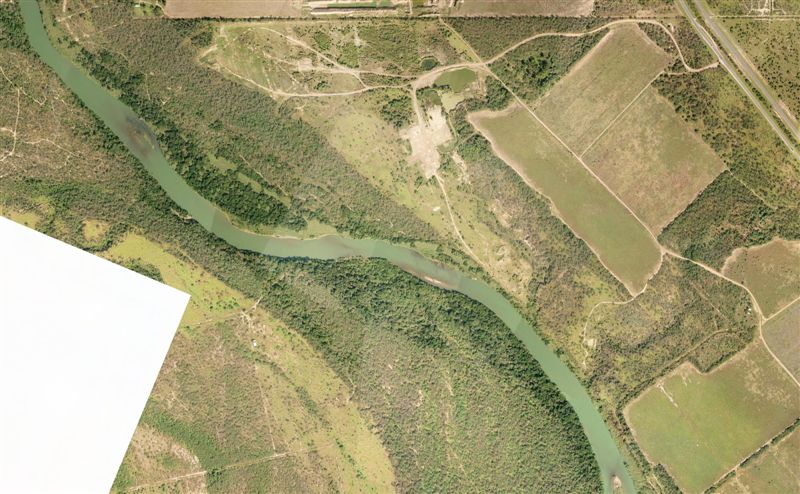
Above is the aerial of the site on the Rio Grande. The property was donated to the city by a local developer. The water rights are essentially free. The city has $6.6 Million to spend on the project - and that was including the bottled water we were given during the site visit - they had no room for over-spending.

It is a very cool site with lots of features - big arroyos, arid vegetation and good materials to build a course.

When the city announced that the $6.6MM included the clubhouse and infrastructure, there was an audible groan from the attendees. Most, if not all, thought it was way too low.

Our team thought it was more than enough. If I write more about the proposal I'll describe how our team was formed -- I think we were the best team for the city.
I wasn't originally going to submit, because of the difficulty in winning a municipal project -- the team was too good to not submit.

Wednesday, March 24, 2010

Golf Architecture Magazine


I've been busy on many smaller proposals, back to the blog soon.

In working on some new materials, I keep coming back to last years Golf Architecture Magazine article by Adam Lawrence. I get's better each time I read it - click the image above to read for yourself - even if you've read it before. website.

Sunday, December 6, 2009

Conceptual Golf Course Routing

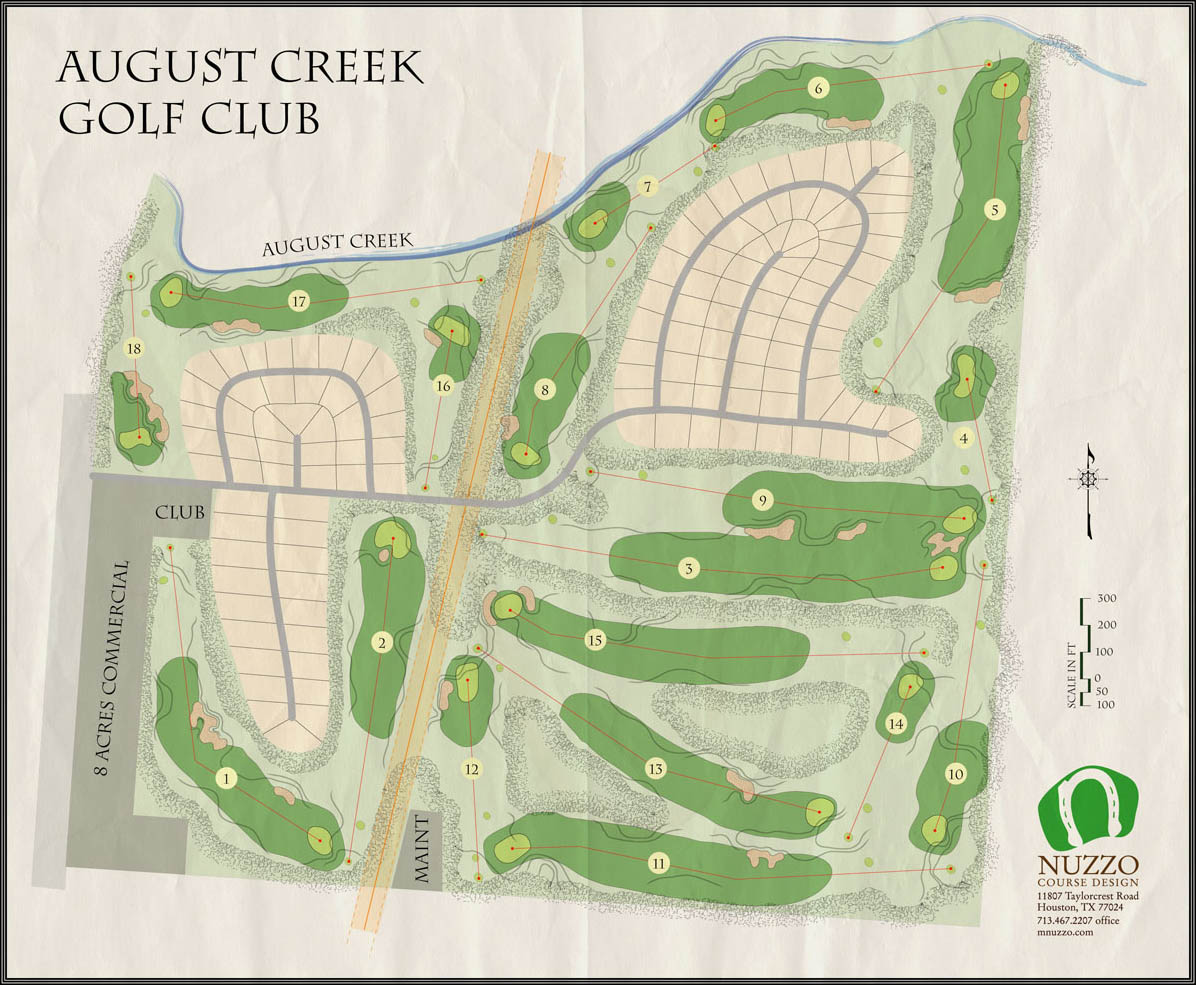
This week I was hired to create a conceptual routing to help determine the feasibility of a golf course on this specific site. The goal was to have it quick and get a feel for what could fit. The above sketch is my first attempt.

The golf course takes up approximately 150 acres.
The lots cover 40 acres.
Commercial and electric easement occupy 15 acres, with an additional few acres for roads.

What I like about the routing:
The course plays along the creek for two spans at different times in the round.
It finishes with some really good holes along the creek.
A player can play 9 holes - or 5, or 12, or 15 holes and finish at the clubhouse.
The optional configurations are due to the triangulation in the lower portion and how the holes intertwine.
It is a very efficient use of the land - which is sandy and somewhat flat.
It would be relatively inexpensive to build and maintain.

What I'd try on my next attempt:
Having the holes play in different directions along the creek.
An internal clubhouse location so 16 & 18 aren't par 3s and returning nines.

Additional Golf Course Routing Resources:
Here is the evolution of the routing of Wolf Point Club
Here is an article I wrote about my routing processes

Sunday, November 15, 2009

Golf Architecture as Art

The following quotes are from the artist of the above self portrait. I thought they were most fitting to also describe designing and building a golf course.

"As human beings we don't view the world like a camera does, indiscriminately treating all details the same. A work of art done from life is the result of decisions made moment by moment by an artist. The result of which is an artistic interpretation of the subject based on the time shared between the two.

“Originality and quality are rarely achieved under such pressure (of a photograph). This same pressure has given contemporary portraiture an artificial, contrived and homogenized look.

As with any collaboration, communication is a key part of the process. If you’re having trouble communicating with an artist, search elsewhere. For an artist, to be chosen for a commission is an honor. Many artists understand the collaborative process and are a pleasure to work with. Finding that artist can be the difference between a work of art that you will cherish for years or a painting that ends up in the attic.”


Tuesday, November 10, 2009

OLYMPIC GOLF COURSE for the MA$$ES

I am not a fan of the newly decided configuration of golf in the Olympics.
The IOC was not interested in golf unless the stars (Tiger) would be playing.
I would rather watch an amateur team match play event.

The following quotes are from a Golfweek published article
"There’s already discussion about building a facility, and that could lead to PGA Tour Golf Course Properties unveiling a TPC-branded layout in Rio, Golfweek has learned."
Their goes that objective position.

“It (the golf course) won’t be some white elephant that’ll never be used again” Ty Votaw
I do not see how that type of course would help grow the game in Brazil.
Expensive and not built by the local workforce.

“Nicklaus Design would be very interested in creating a Jack Nicklaus Olympic Golf Facility for Brazil”.
It seems odd to place anyone's name before the word that has defined sport for 2,785 years.
This doesn't smell like the best thing for the game either.

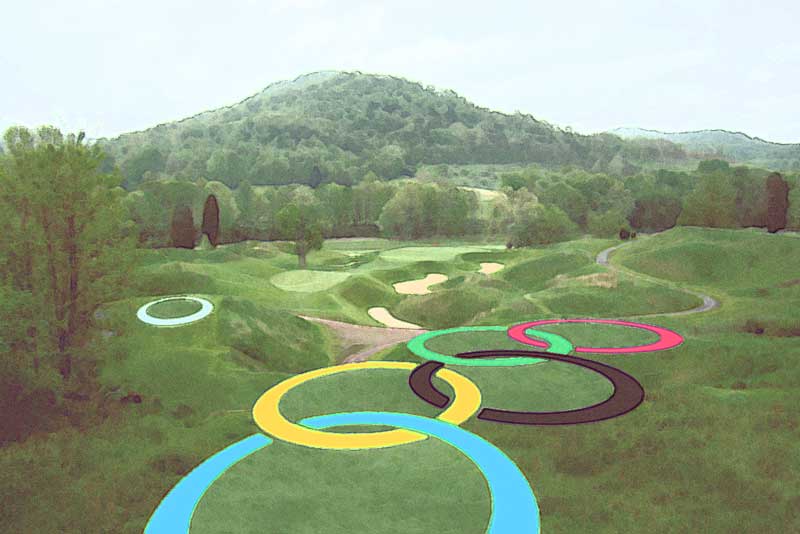
At top is my illustrative guess for what will be created for the Olympics.
And a quote from its designer:

"We decided to build five sets of tees so every nation in the world would be able to enjoy the new TPC Olympic venue. We also added a 6th tee to represent the future growth of the game in Antarctica."

I don't think 99% of the world will need the back four tees of any course that gets built.

Wednesday, October 21, 2009

There is no Greatest Golf Course! - Feedback


Thomas Dunne from Out-and-Back had some very nice comments about my essay here

I was completely chuffed to receive an e-mail from someone who read my essay - in print form from Paul Daley's Book.
Here it is with the club name removed...
I have just read your article in Paul Daley's latest book. At our club we have a MacKenzie course which is rated very highly in the world. Needless to say being a MacKenzie course it fits into the enjoyable category; a sentiment confirmed by Bobby Jones in his forward to "The Spirit of St Andrews". I am a member of the Course Strategy Committee and some on the committee and a number of the club members are saying it is too easy. Of course, when I try to say MacKenzie wrote, "If you cant make a hole more enjoyable don't change it", my remarks are treated as those of an old has been, who can only hit the ball 2/3 the distance of the average single figure marker (if that).

Mike, with your permission I would like to make copies of your article and give each member a copy. With help from your article, I just might be able to save one of the most enjoyable golf courses in the world from suffering the fate of so many other enjoyable courses from the "card and pencil' players.

Thank you very much - I am deeply honored.

As an aside the above letter came from a past club champion -- I hope they listen(d) and continue to do so - he is far to valuable.

Pictured above is the very fun 17th green. I hope you can see that from above it looks like a circle - see here.

Sunday, October 18, 2009

Green Theory Notes

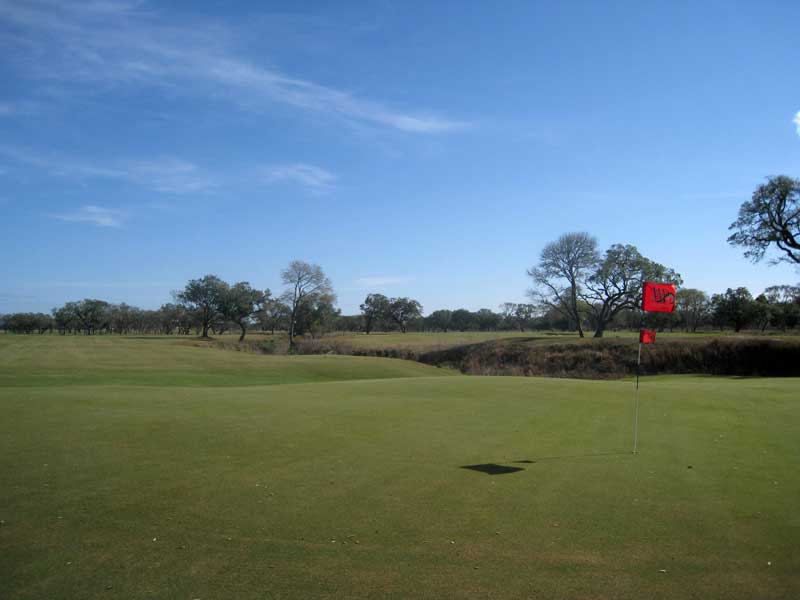
Some notes on our Green Theory and what we created at Wolf Point (2nd green pictured above):

There are no rules - the following are some observations from our work.
Greens fit the client and the business model, including maintenance goals
An open green front for run-up shots – few forced carries
Each green will be original and different from the rest and in the same family or seem related.
Proportional variation - some may look the same but play different.
Fit settings without any conspicuous or artificial mounding
Contours vary from subtle to bold – with no distinct levels or shelfs – more like soft organic folds
Accentuated by micro movement and drainage exit points in multiple locations
Simple circular mow patterns that would ideally blend into the subsequent teeing complex
Start with a minimum of pin settings and area based on amount of play
Rewarding of multiple approach angles based on client – front, left, right, back and multiple - which is generally accomplished with varying tilts and surface biases
(Based on client as a private club may have more greens that run away from the player)
Wolf Point is unique in total rounds will never be over a few thousand – so we designed as fun as possible – the client will be playing every single day – we needed to keep it interesting every day.
Preliminary sketches may look simple – but they are rather complex upon description
Their interest comes from the 3rd dimension

From above the greens appear as circles or ellipses – no squiggly mow lines creating artificial interest – same with the fairways.
Wolf Point greens are Emerald Bermuda – in fitting with the clients maintenance requirements
The immediate surrounds are also Emerald Bermuda – allowing for full circles and uniform water requirements
The greens mix was excavated from on site – at an installation cost of way less than $1 a ton. Morris Brown and an agronomist preferred the native materials over a spec mix.
The roots are currently over 8” long and performing great in this drought year.
The above two items saved approximately $500,000 at Wolf Point and will be a consideration for all my future warm season projects.
Greens should roll at speeds appropriate to the clientele and slope
At Wolf Point they will roll up to a 10+ and are VERY FIRM
Sizes range from 4,500 to 10,000 sft.

Sunday, October 11, 2009

There is no Greatest Golf Course!

There is no greatest golf course: there are only greatest golf courses
Is the title of my essay in the most recent of Paul Daley's outstanding books: Golf Architecture a Worldwide Perspective Volume V.

Why does the golf course industry segment courses in a way different from the way that people who play golf enjoy the game and its grounds? Why are there such differences between what the magazine rankings and also players consider to be the greatest course?

Please read the essay here for the detailed answers. The short answer is that there are different types of players and golf courses. The world's greatest courses weren't built for everyone, they were crafted for a specific client. It became much easier to express my existing thoughts after viewing Malcolm Gladwell's discussion on spaghetti sauce. Please read the essay and watch the video - it is worth sharing.

Cheers

Thursday, March 12, 2009

Where can someone go to learn about developing golf?

I was describing to Will at the recent ULI conference that for the past couple years the developers of resorts have been asking how to develop golf for less. The number that gets bantered around is $14MM for a resort course. So what was the response from the golf architect community? -- design 3-6 hole golf courses!!  

"No wonder no one is coming here any more.  If all you've ever done is build 14+ million dollar courses and we've proven that model doesn't work, why in the world would we listen to anything that the experts have to say? We should be doing the opposite of what you've done. Your solution is to build 3 hole courses?"  -- Will

Last year someone asked me "Why do I need a golf course?"  He was told that he needed golf to have a successful resort - but he didn't think it was good value.  Where can someone go to learn about developing golf if not here?

Golf is too expensive
Golf is too hard
Golf is only there to sell real estate

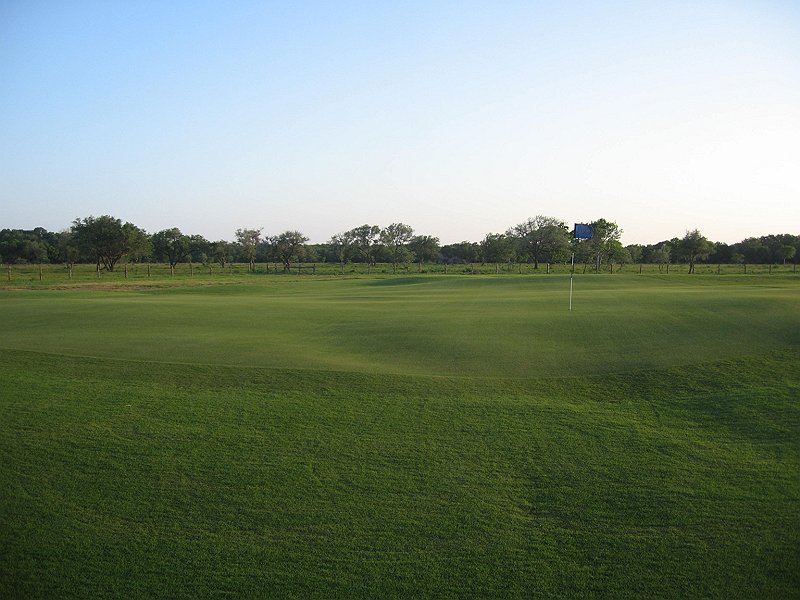
Pictured above is the 16th green at Wolf Point.  Our answer.  We'll be talking more about the questions next week.

Sunday, January 18, 2009

"The Cruel Shoes"

Below is a story by Steve Martin that was also the inspiration for the name of a compilation of essays published called Cruel Shoes.  If you are unfamiliar with the story please skip to below.

I recently saw one of the most horrendous golf holes, ever.  It looked like the cruel shoe with the razor blades.  It was so forced into the property with rediculous shot requirements that no one could ever enjoy playing such a travesty.  The green complex was hideous and made my stomach hurt.  Why could such a thing happen?  The course was designed by the owners who had little understanding of the golf course routing.  Creating a golf course is a dream and often even a novice could create a good hole here or there.  It is the expert that is required to build an entire course of sufficient quality that people would want to play for generations, and so it can be maintained efficiently so as a business it can survive for just as long.

Cruel Shoes:   Youtube version.

Sunday, May 4, 2008

The 3rd Green - an architectural like

My second hole for the day was the par five 3rd. The first time I played it cautiously. The second time I missed a bit. Both times I played down the right side (the less advantagous side). Both times I tried to do too much with my 3rd shot knowing how difficult it would be from the far side of the fairway. Both times I made a bogey. I was enjoying my round so much I wasn't really paying too much attention to the course, I was soaking up all the other elements of the day - mostly the fruition of all our hard work.

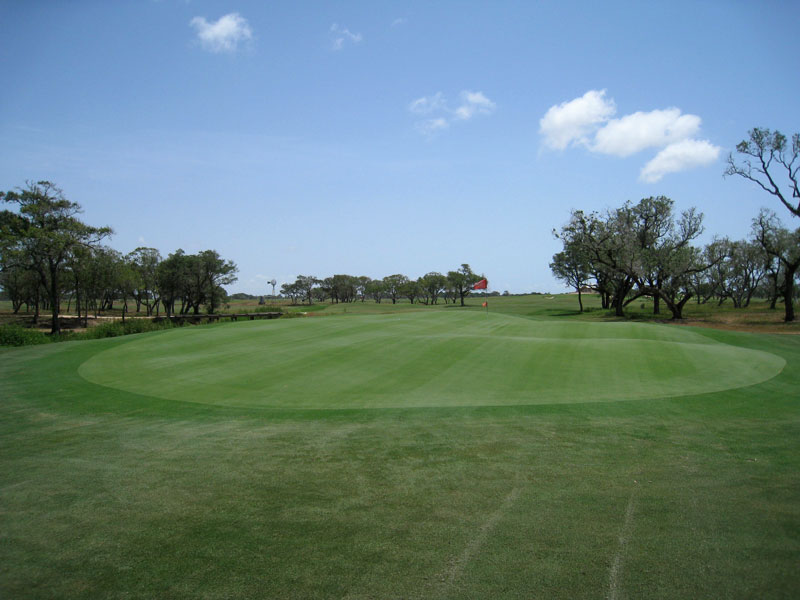
The above picture is of the 3rd green and the two heights of cut around the course. The green is surrounded by a tight fairway cut that extends througout the entire hole. No collar, no intermediate rough. I love that there are only two heights of cut through the green throughout Wolf Point.

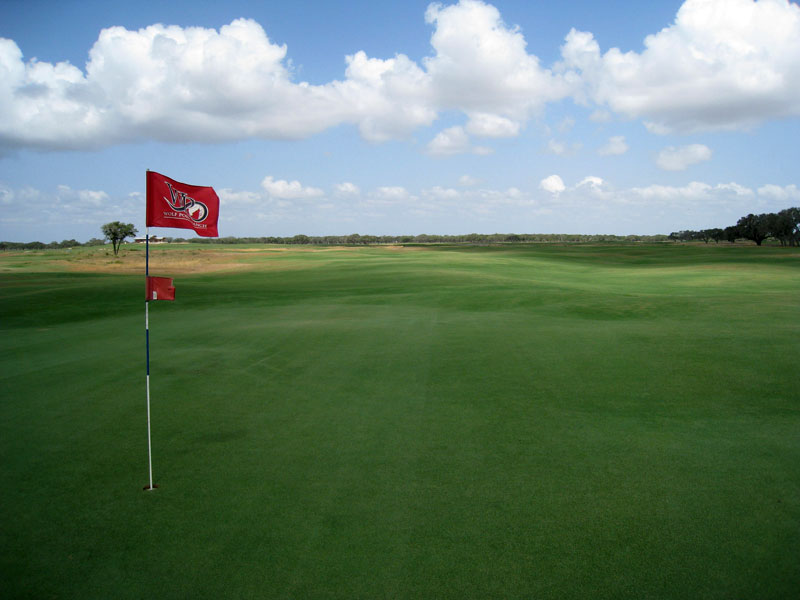
The following picture is the opposite and one of my dislikes that didn't make my previous list. Please notice how many different heights of grass cuts are in the following picture all within a few feet of the green.


Not very practical, I don't like the playability, higher maintenance costs and I think it looks funny too.

Monday, March 3, 2008

Golf Architecture Volume 4

Paul Daley's next volume is on its way to the publisher. Yesterday's mention of my upcoming essay was referring to this edition. I was very pleased to have the pictorial essay entitled "Wolf Point Club Routing, USA — An Evolutionary Case Study" included. They are due to ship sometime this spring. The above is the cover image and here is Fullswing Golf Publishing's website - which should be updated soon - Paul has been quite busy putting it all together.

All of his books are excellent. I recommend picking up his past volumes, especially Volume 3 which included the following essay "Non-traditional paths to becomiong a golf course designer".

Sunday, March 2, 2008

Routing Plan and As-Built

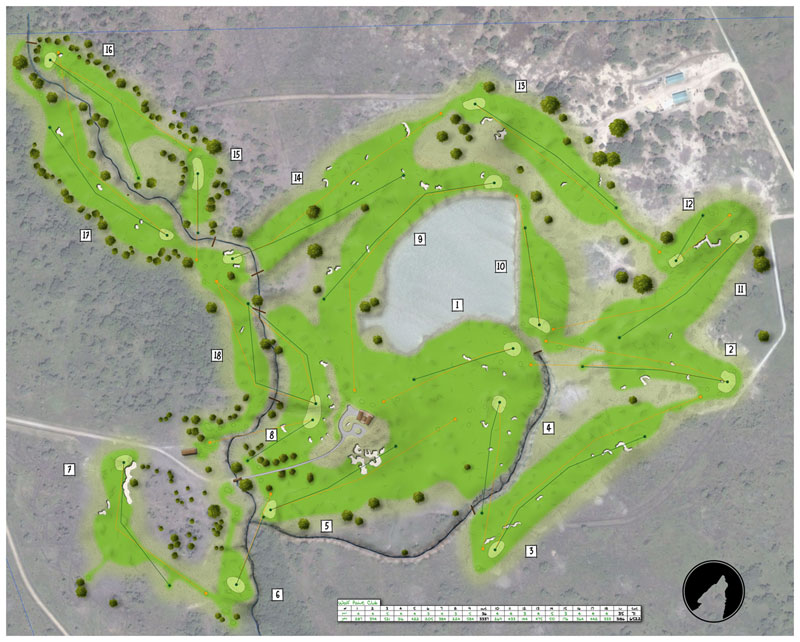
Here is Wolf Point Club in its entirity. The above image is the as-built routing plan. The design, GPS acquired data and the most current aerial photograph all laid out together. I've gotten some very nice feedback from those that I've show the plan and the person who has seen it most always thought it was exceptional. This spring an article about the evolution of the routing will be published. I look forward to sharing the process in detail here.

Monday, January 7, 2008

Architectural Dislike #8: The new bunkering at Riviera's 10th

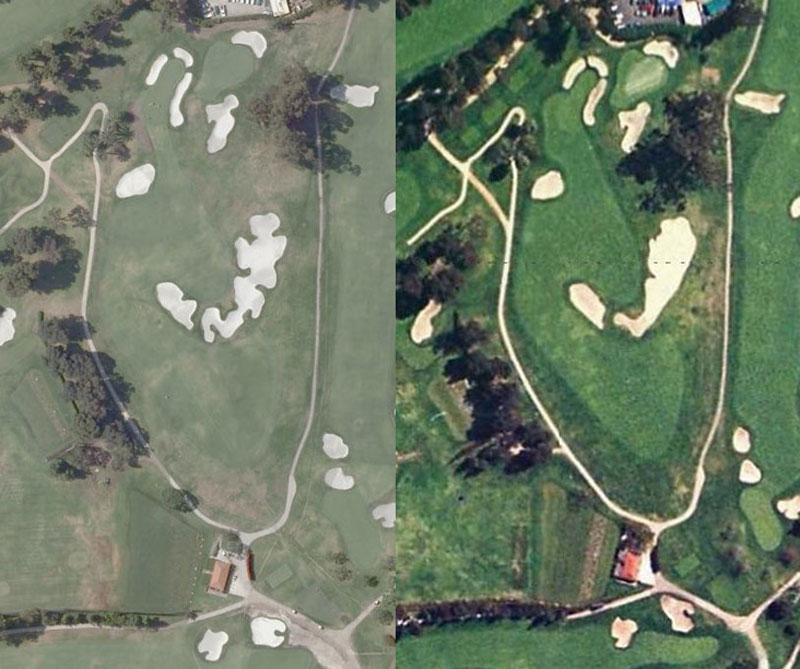
Since the course opened in 1927 the bunkers and course has been evolving and changing. Restorative bunker work was completed in the early 1990's. Since then the course has been undergoing additional changes. The above picture was taken from satellite imagery after (left) and before (right) the most recent work to #10.

The tenth hole is one of the most famous and architecturally significant holes in the US. When I first saw the new version - on the left - I thought someone had photoshopped the bunker as a joke. Turns out it wasn't. Were there reasons to change the bunker? Probably several. When I last saw the course it was hand raked - maybe it was too much raking when hitting it in the middle of a bunker - thus the added fingers. Maybe it fits in better with all the other changes that have occurred - why was this one done near the end? It looks like a lot more maintenance work now.

What I like least about the new bunker is that is clutters up the view of a beautiful hole. The bunker is now distracting and is screaming "LOOK AT ME!!". It draws my eye all around the shapes and doesn't give enough importance to the green and overall strategy. In my opinion it was also historically significant and worthy of preservation - not modernization.


This is my last dislike - here are the others: 1 2 3 4 5 6 7.
I thought it would be fun to continue what Ian Andrew had started on his blog, it turns out it wasn't as enjoyable as I'd thought.

Friday, December 28, 2007

Architectural Dislike #7: Long Walks from Green to Tee

The two most important parts of designing and building a golf course are starting (the routing plan) and finishing. A good routing almost always keeps the holes close to each other with short green to tee walks. It provides an intimate setting and facilitates keeping a continuity while playing. The time to reflect and enjoy ones time on the course is when walking from the hitting spot to where the ball comes to rest.

The above picture is from a very memorable round I played a few years ago. I highlighted the ride from a green to the next tee. I say ride as it is an impossible course to walk. It was incredible the number of long walks on the course, which in great part lead to this being one of the worst courses I've ever seen.

Wolf Point's total walk from the first tee to the 18th green is approximately 4.3 miles. The walks from green to tee are miniscule. For reference the above pictured course's walk would have been above 7 miles - if one was allowed to walk.

Friday, December 21, 2007

Architectural Dislike #6: Golf Stuff

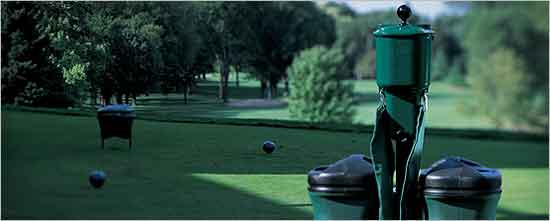
I sure wish there was no stuff on a golf course. There isn't at Wolf Point -- every visible outside element takes me further away from the game. I vividly recall once using a ball washer as a target on one of the finest holes in the world. It helped me hit a great shot but left an aftertaste. It has been a goal to avoid as many visual distractions as possible: grass lines, trash cans, cart paths, irrigation satellites, tee markers, the pump station, rakes and ball washers especially.

Wednesday, December 19, 2007

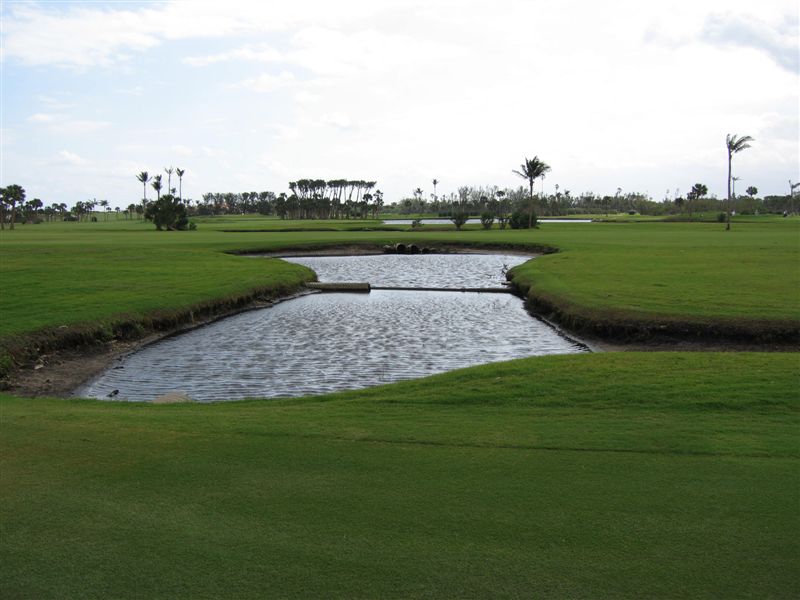
Architectural Dislike #5: Small Ponds

Ponds as small as a bunker! I also mean the ones a little bigger too. I've seen lots of those, especially in Texas and Florida. Yes they are used as collection spots to drain to and then later overflow into larger areas. Yes they can be needed on flatter sites. But they don't have to be directly in play. Only one time have I seen a small pond look bigger - due to the geometry and the plantings.

There is not mistaking what we created at Wolf Point - it is a big pond (13 acres) and a setting in itself not just trying to add to the existing setting. It is very peaceful watching the choppy water and feeling the breeze at the end of a long day.

Sunday, December 16, 2007

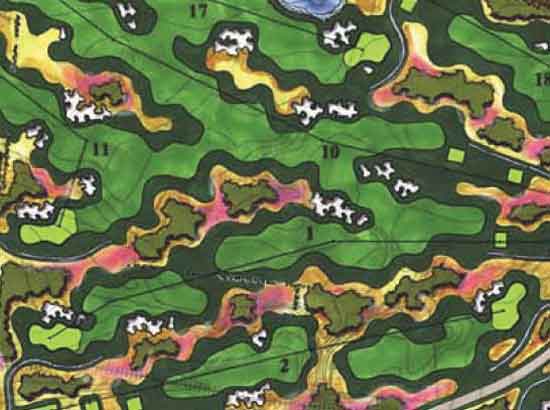
Architectural Dislike #4 : Swoopy

I hate swoopy. Swoopy is the term I use for a regular wavey shape. Swoopy fairway lines are often used to create artificial interest in fairways where there is no interest. Or the grassing lines are made swoopy to go around the artificial containment mounding. Greens are made swoopy for the same reasons too, and bunkers while usually a different swoop frequency are still swoop to me. The picture above has all the swoops swooped into one.

There is no swoop at Wolf Point. The interest comes in the form of three dimensional irregular movement - rumples and waves.

Tuesday, December 4, 2007

Architectural Dislike #3: Truncated Cone Tees

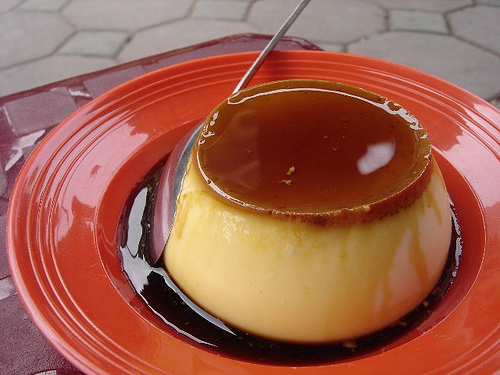
Again I'm a bit at a loss for a good picture to illustrate my dislike. I should note to collect more pictures of what I don't like to share with future clients and shapers. So in doing a web search for truncated cone - the above picture turned up - which is far more appetizing than as a tee.

There was and is a predisposition for the golfer to want to see the entire hole when on the tee. Hence the popularity of the elevated tee. I do not like when all 4 or 5 tees are separate land forms that all look like volcanoes. They are artificial looking, hard to climb, harder to maintain and build and they can posses a safety risk. I think their overuse is indicative of a poor routing plan. You won't see any of these at Wolf Point Club.

Pictured is a Crème brûlée.

Architectural Dislike #2: Bunkers that require mechanical rakes

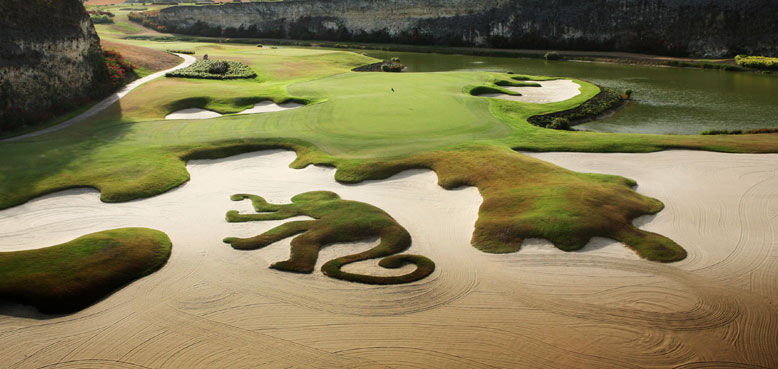
This picture is a twofer. I certainly don't like Mickey Mouse bunkers - and that was going to be a dislike, but looking at this picture got me thinking how I dislike bunkers that require a mechanical rake more. The long rake lines in the above picture are indicitive of the mechanical rake.
The size drives up the maintenance costs by increased labor, equipment, fuel and increases the likelihood of damage.
This is a good example of where the golf hole could have looked great without any bunkers. It is competing with this naturally beautiful area.
The bunker seems to be artificially large to make room for the monkey and the excessive fingering.