Showing posts with label published. Show all posts

Sunday, April 4, 2010

Houston Chronicle Names Swanson's Best Practice Facility

BEST PRACTICE FACILITY
Swanson Golf Center
Matt Swanson’s Golf Center is the one-stop practice facility, with a driving range, short-game practice area, teaching pros and club fitters on hand to take your game to the next level.
It was the clear choice, mainly because it improves and expands so well on the basic concept of a driving range.

The results
1. Swanson Golf Center.....19.3 percent of vote

Insiders say:
Swanson received an even stronger endorsement.

The best golf in Houston and beyond
Golfers are used to making a lot of decisions. Perhaps that’s why so many of them volunteered for the somewhat daunting task of participating in a survey that included choices galore.
Golf Guide 2010 reveals the pulse of the more than 1,000 area golfers who filled out the survey at chron.com.

To compare the thoughts of the average player and those inside the golf industry, we also made a separate version of the survey available to more than 300 club pros, superintendents and others who make a living at golf, a group we’ve dubbed the insiders.
Here is the link to the full article


Wednesday, March 24, 2010

Golf Architecture Magazine


I've been busy on many smaller proposals, back to the blog soon.

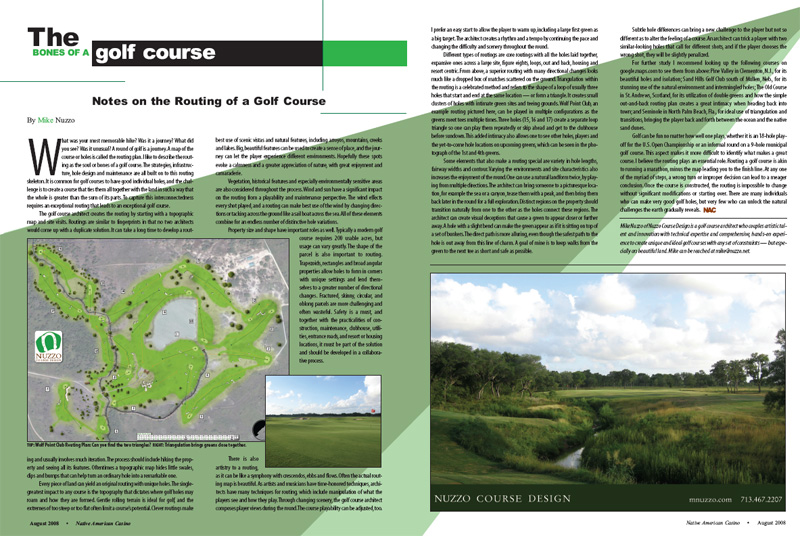
In working on some new materials, I keep coming back to last years Golf Architecture Magazine article by Adam Lawrence. I get's better each time I read it - click the image above to read for yourself - even if you've read it before. website.

Wednesday, October 21, 2009

There is no Greatest Golf Course! - Feedback


Thomas Dunne from Out-and-Back had some very nice comments about my essay here

I was completely chuffed to receive an e-mail from someone who read my essay - in print form from Paul Daley's Book.
Here it is with the club name removed...
I have just read your article in Paul Daley's latest book. At our club we have a MacKenzie course which is rated very highly in the world. Needless to say being a MacKenzie course it fits into the enjoyable category; a sentiment confirmed by Bobby Jones in his forward to "The Spirit of St Andrews". I am a member of the Course Strategy Committee and some on the committee and a number of the club members are saying it is too easy. Of course, when I try to say MacKenzie wrote, "If you cant make a hole more enjoyable don't change it", my remarks are treated as those of an old has been, who can only hit the ball 2/3 the distance of the average single figure marker (if that).

Mike, with your permission I would like to make copies of your article and give each member a copy. With help from your article, I just might be able to save one of the most enjoyable golf courses in the world from suffering the fate of so many other enjoyable courses from the "card and pencil' players.

Thank you very much - I am deeply honored.

As an aside the above letter came from a past club champion -- I hope they listen(d) and continue to do so - he is far to valuable.

Pictured above is the very fun 17th green. I hope you can see that from above it looks like a circle - see here.

Sunday, October 11, 2009

There is no Greatest Golf Course!

There is no greatest golf course: there are only greatest golf courses
Is the title of my essay in the most recent of Paul Daley's outstanding books: Golf Architecture a Worldwide Perspective Volume V.

Why does the golf course industry segment courses in a way different from the way that people who play golf enjoy the game and its grounds? Why are there such differences between what the magazine rankings and also players consider to be the greatest course?

Please read the essay here for the detailed answers. The short answer is that there are different types of players and golf courses. The world's greatest courses weren't built for everyone, they were crafted for a specific client. It became much easier to express my existing thoughts after viewing Malcolm Gladwell's discussion on spaghetti sauce. Please read the essay and watch the video - it is worth sharing.

Cheers

Thursday, May 7, 2009

Golf Course Architecture Magazine #16


Golf Course Architecture Magazine has recently launched an updated website. Fortunately they have also featured an article on Wolf Point that is also on the website.

Tuesday, September 30, 2008

Sunday, August 3, 2008

Routing Plan #11

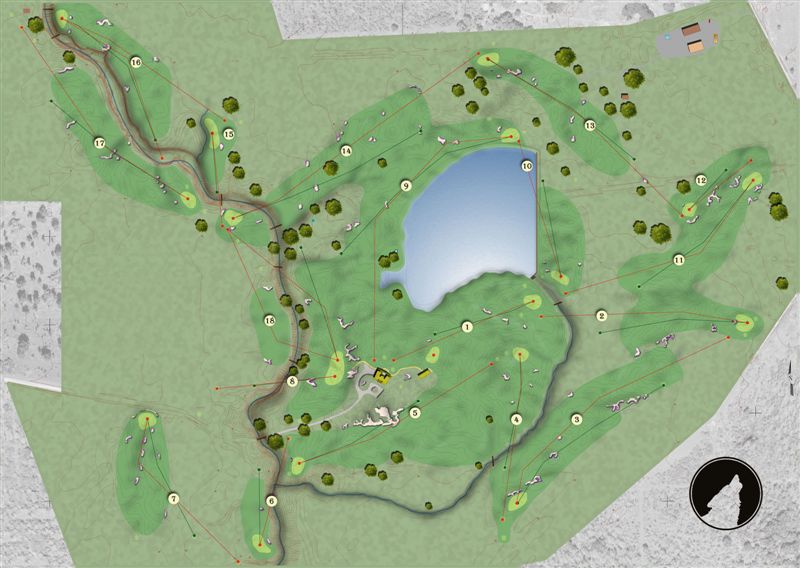
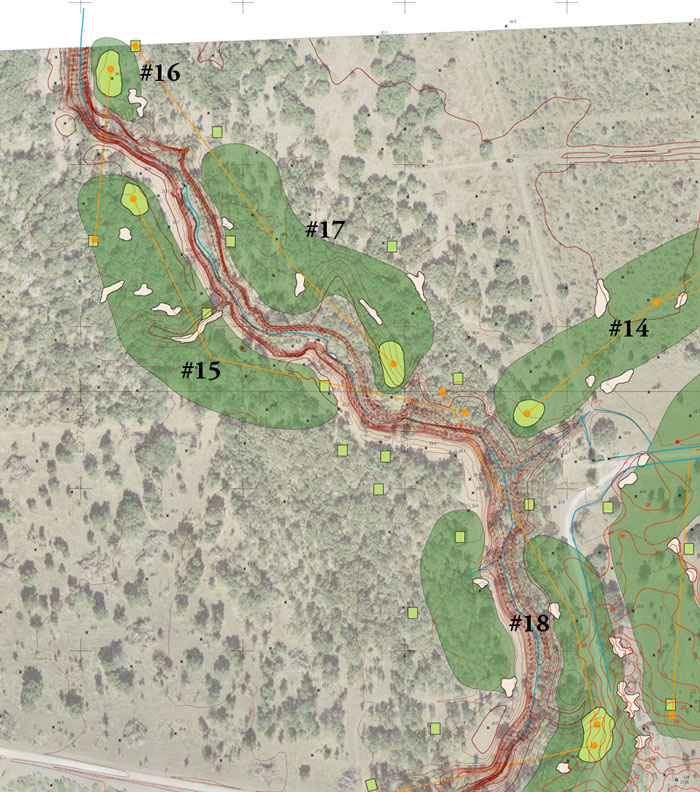
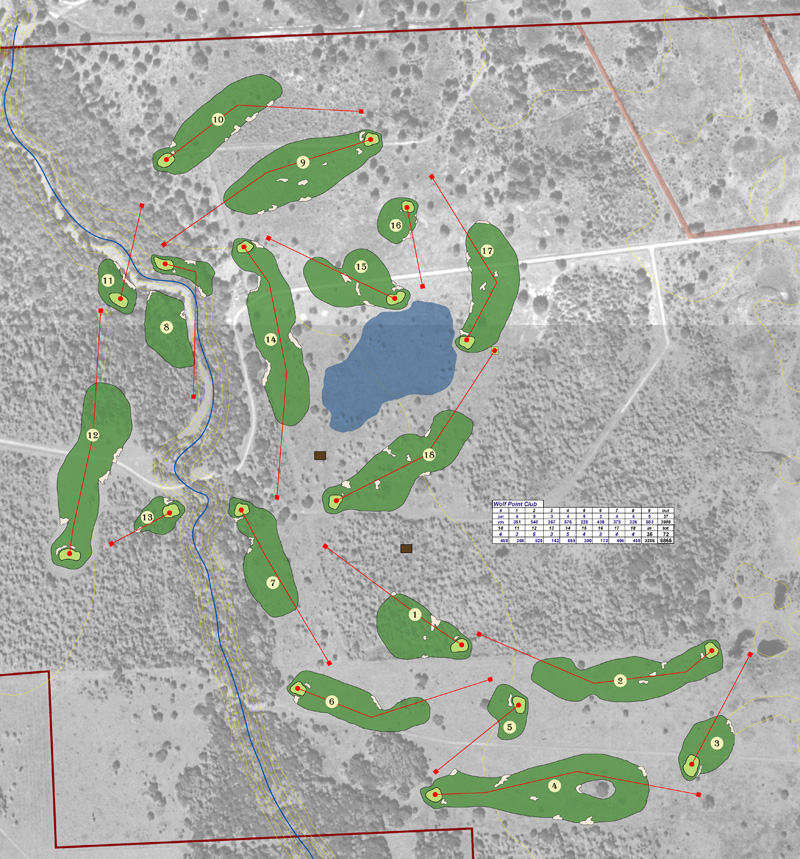
Nine months in is when we finalized the above routing plan. We had cleared the creek for the potential 16th hole, and with a better look at the property it the holes along the creek were going to be much more practical to build and I think way better. They turned out great.

Previously I was asked about the tees that have started showing up on the plan. On this version you can see two sets of center lines. The red are the regular tees (approx 6500 yds) and the green are the forward tees (approx 4500 yards). There are also several other light green circles spread around each green. The philosophy is that what ever hole length the player prefers, it will be a minimum walk to the next tee. As a very private course we were able to surround the greens with potential tees. They aren't traditional looking if anything they are hard to find - as they blend into the green complexes. For the 4500 yard tees I had fun placing them in very strategic locations - there are also many other options if one didn't want to take on infierno bunker.

We found ideal tee locations for having the stratagies play as differently for every hole as possible - also taking into account the strong prevailing winds. With so much fairway the winner of the hole can choose almost any spot to tee off from. And there are several cross country holes to choose from as well as a few backwards ones
.

The tree shows up now in the middle of the 14th and the bunkers are becoming finalized - with some more changes yet to come...

Wednesday, July 23, 2008

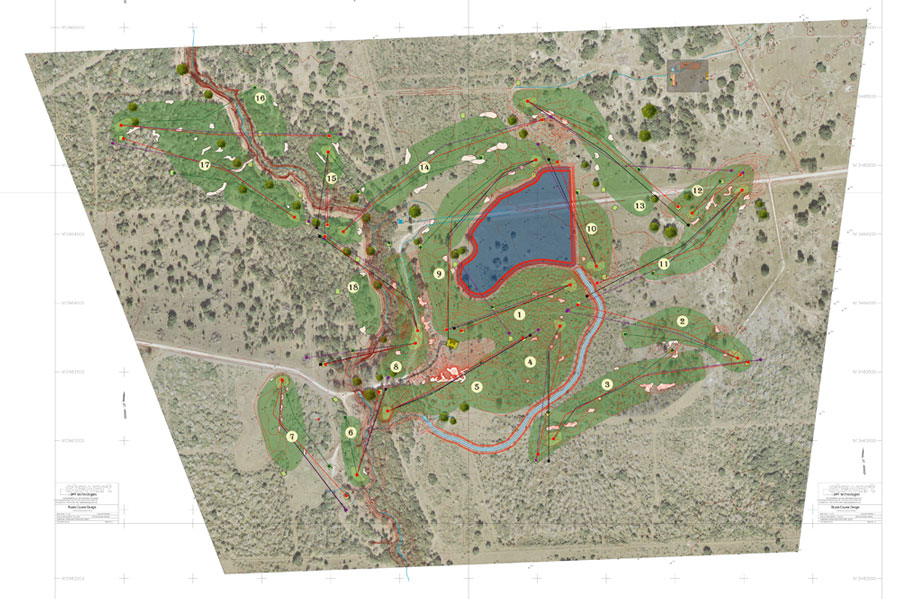
4 months in...

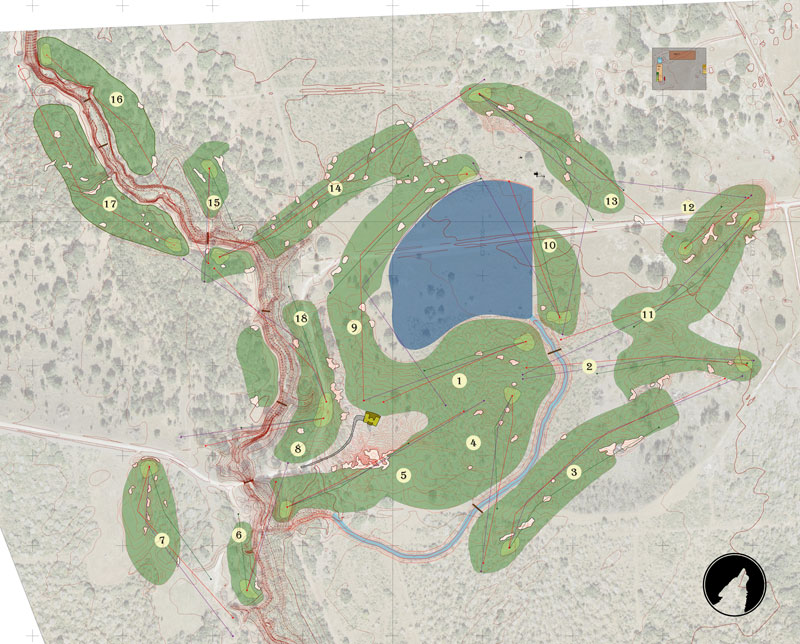
Routing 10 can be seen above. We started clearing and some preliminary site work - we were looking to find all the sand. There was a great deal of sand beneath a layer of clay throughout the site. We were looking for the best sand.

The biggest change is the new loop of 15-17. It now goes around the creek counter-clockwise. This is still a proposal and we didn't commit to this version until several months later. We started construction in the ranch and by the time we got to the creek we decided. This was a definate benefit of building it slowly - it was much easier to make changes based on how the course was developing.


“The ultimate character of the course must be developed as the construction progresses” - William Flynn

Another major change was the conjoining of holes 2 & 11. It was the repositioning of the 3rd hole to make use of a nice stand of trees that drove the shift. And the benefit was a really large fairway. The left side of #3 also became much straighter. The goal being when standing on the tee the green looks like it is sitting directly on top of the fairway bunkers - along the line of charm.

You may also notice a lot of bunkers out there - that have been shrinking and shifting quite a bit - for now they are just looking good on the page - we will build what makes the most sense in the field.

I have a few more routings to share and will continue to discuss the evolution as recently published in Paul Daley's new Golf Architecture - A Worldwide Perspective.

Wednesday, July 16, 2008

Routing Plan #9B an interesting choice


I like triangulation - when 3 holes make a small loop. They head in different directions and allow for different orders of playing the holes - as multiple greens and tees meet at congregation points. Routing plan 9b came about at the same time as routing plan #9 and flipped the triangle of 15, 16 & 17. Making this sort of adjustment is also an advantage of using small loops.


In this version the 14th hole was shortend from a par 5 to a par 4 with the green on the near side of the creek - it would be a nice green site on either side. I liked the non-forced carry of the 14th as a par 4. This would change both the orientation of the next 3 holes relative to the creek - the hazzard would be on the fade / slice / right side of the player - and change the par sequence from 3,5,4 to 4,3,4. The teeing location for 18 would also change slightly - but not the fairway.

Negatives: 14, 15, 17 & 18 would all be par 4s - I'm striving for as much variety as possible - and this would be a tiny negative. The 16th green was going to be too close to the property line.

Positives: Changing #16 - I do not like this hole on plan 9 - it seems a little forced - and it was as I forced the green down away from the property line. Don liked the natural look of the holes on this version.

To this point my client was not involved in the "design" of the course. I wanted to get him more engaged in the process - to include his preferences and hopefully like the finished product that much more - he chose plan 9 over this version. He liked the forced cary to the green over the creek. While his first remarks were to make the course fun, he had since been very encouraging of making it challenging - with a home field advantage.

There are bits of stragey from great golf courses imbued in Wolf Point Club - NGLA - Seminole - The Old Course - Royal County Down - and it wasn't until several months later that I learned what other course had an influence on Wolf Point Club. Our client chose the green location for its difficulty but it was also similar to a hole he had been playing recently. Maybe one day I'll add the name of the course to the end of the above list - but not any time soon.

With hindsight and a better understanding of the land - this loop of holes would have been excellent too - I'd have loved to played them.

ENJOY THE OPEN!

The the next several posts I'll continue to discuss the evolution of the routing plan at Wolf Point Club as recently published in Paul Daley's new Golf Architecture - A Worldwide Perspective.


Monday, July 14, 2008

Routing Plan #9 new aerial & topographic map


The first difference I notice with this routing plan (#9 which is about 2+ months in) from routing plan #6 is that I'm working with a new aerial photo and topographic map. The site was flown and the stero photographs were compiled into a 1' contour map. Having this detial alows for more efficient planning of drainage, irrigation and earthwork. It is a necessity. Another addition is I've located some specimen trees via GPS - I walk around the site mapping interesting features - drainage swales, green locations and nice trees. This is also about the time where I started walking the site with the above plan incorporated into the GPS receiver - so as I always know where I am relative to the yet to be built golf holes. I can stand on the planned 5th green location before we start - and make any adjustments or keep it as planned.


The maintenance facility is also more refined - Don Mahaffey was definately involved at this point prior to moving down to Texas. The location for the facility was close enough and also had two major benefits - hidden from the course and has good access from the road. It was a natural clearing just the right size - so we also didn't have to clear at all.

Another refinement was the finalization of the access road and the main clubhouse. In version 6 the clubhouse is closer to the lake - which was more in line with the building architects original plans - more on a bluff. With the 2 options in hand our client chose what I now consider to be the best option. The four holes surrounding the clubhouse have conjoined even more than before and form one of the biggest lawns I've ever seen.

The 7th hole was also shifted to allow the current road to provide access. This would also create an entrance road that winds surreptitiously around the property before entering in the back of the golf course - it creates a very cool reveal - which is a foreshadowing for the reveal when you travel through the clubhouse to the above mentioned view.

The 9th and 14th fairways have also started to touch - they will do more so as we evolve. With more time on site the strategy of the 5th hole can be accomplished without any green side bunkers - the green site is surrounded by natural drainage swales - these land forms would be used as a style for areas that needed to be created.

I have lots of great new pictures from my last two visits and also a couple more birdies to talk about - there are 2 more holes in play.

The the next several posts I'll continue to discuss the evolution of the routing plan at Wolf Point Club as recently published in Paul Daley's new Golf Architecture - A Worldwide Perspective.

Sunday, July 6, 2008

Golf Course Routing Plan #6


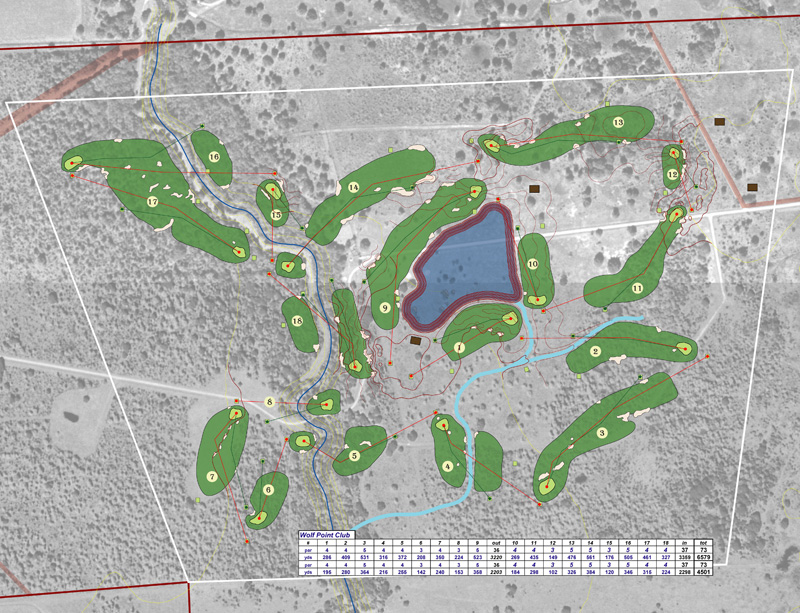
My conceptual design work stays in one file. I create many simple schematics of hole centerlines before I commit to any type of strategy or detail, like fairways. I keep all my iterations on separate layers and can easily track the order and see other versions at any time. Between looking at older versions and working on new concepts - plan 6 from above was sketched - not too long after plan 5. To a casual observer it may appear as if the changes were only minor - but with the knowledge of how the holes turned out - this was a huge jump.


One item I haven't discussed much is how much earth was moved during the creation of Wolf Point Club. Hurricane Rita hit Texas between routing versions 2 and 5 and it was requested to raise the main clubhouse in case "the" big one ever made a direct hit. At one point the Rita's path was tracking directly towards the ranch. I wouldn't have suggested it from a golf perspective, and it was impossible to suggest an alternative given the location and all the freedom I'd been given to that point. The lake keeps getting bigger to get the clubhouse higher.

The most obvious change from 5 was the orientation of holes 12 and 13. The intent was to have 11 & 12 use a single land form as a feature and then 13 flipped over. A small point but you'll see a small rectange - pump house location - on the lake edge inside the holes.

I started to condense the routing and got the 4th and 1st fairways to touch - which caused the 2nd and 3rd to shift tighter as well - while not a big deal in this version - this compression trend has lead to one very unique setting.

I think the condensing came about because of how I modified the 5th hole. What ever came first, the 5th hole became world class because of the change. At this stage the green site is based on a great location from walking the property. The inspiration for the hole may be recognizable based on the bunkering. Can you guess?

I continued with the compressing of the course to shorten the walks from every green to the next tee. As a result I shifted the 7th hole and progressively shifted the 8th green towards the 9th tee. One day I took a big gulp and decided to try combining the 8th and 18th greens. I say gulp because I've seen so many poor versions of a double green where they may be artificially connected by a sliver of green grass. These were going to form one large oval and be separated by a swale. Pictures of the green are almost ready to show - it is very impressive.

For the next several posts I'll be detailing the evolution of the routing plan at Wolf Point Club as recently published in
Paul Daley's new Golf Architecture - A Worldwide Perspective.

Wednesday, July 2, 2008

Routing Plan #5 - East to West

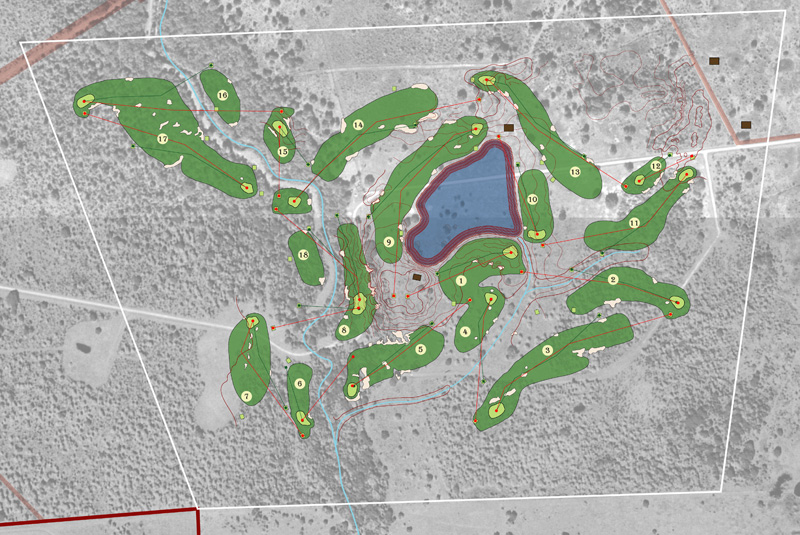
Fast forward two months and I had the above routing plan - it is more than the 5th version, but I number them like software with only major changes getting a new number. The request after my initial plan was to have to the course follow a more east to west orientation and the ranch would be a significant part of the course.

Initially I considered keeping the irrigation lake away from the course - but with not many major features it seemed that it would be best for this client - so I kept the lake large - actually alittle bigger from the first version to create a sence of place.

After several more visits the above plan was created. I drew up an artificial boundary - white trapezoidal line above - to keep away from the property lines and to give myself a target area to work in - with too much space it can be hard to visualize the best locations. I had visited Seminole Golf Club during this time because of some potentially similar terrain - Seminole's property is a trapezoid with each nine split in a triangle.

I created a ditch to act as an outfall, and tried to create as many strategic fairways as possible. I overdid it and spent the next several versions backing off the diagonal carries. There were 5 fairways with two landing areas - as a hint: the only one that remains is the 18th hole with the creek running down the middle.


I was very happy with the way the holes started in the ranch, moved towards the creek, back to the ranch and finished along the creek - it could make for good transitions and wouldn't create a ranch nine and a creek nine. I was still focused on getting the course to the nice motts of live oaks in the north west corner.

The brown squares are the clubhouse, pump house and maintenance facilities - moving left to right.

For the next two weeks I'll be detailing the evolution of the routing plan at Wolf Point Club as recently published in Paul Daley's new Golf Architecture - A Worldwide Perspective.

Monday, June 30, 2008

The R Routing Plan

Wow. It was only two weeks into the project. I was very excited about the prospects and details. Here were my constraints: very private, don't loose a ball in long grasses, very fun, very windy site, raw materials nearby - sand, challenging, lots of land and wind! Today it still sounds like The Old Course at St. Andrews.

Today and for the next two weeks I'll be detailing the evolution of the routing plan at Wolf Point Club as recently published in Paul Daley's new Golf Architecture - A Worldwide Perspective - Yesterday's Blog.

The above image is my first routing plan to get a feel for the client and the land requirements. My goals were to minimize expenses - I keep the holes in the cleared areas and tried to locate the lake where some sand could be excavated. There was also an preference for the motts of live oaks on the site. Note how the 4th hole plays around a large Oak.

This first solutions high points are that the holes play in a variety of directions and are varied in length. The fairways are also wide. I definately stayed in the cleared area - the 12th hole is in an old drilling area - note the fairway mimics the clearing - that is what I'd call fitting a hole to the site. The 18th hole at NGLA finishes along the clubhouse - so did this version.

Early routings generally have a looser hole spacing - I tighten them as they evolve - but I have no idea why I kept 7 green so far from 8 tee other than the walk from 13 to 14. Early routings usually also have lots of big bunkers - it looks better on a drawing. Unfortunately many times they get built that way too. I think the best method is to keep the best ones and lose the rest - Don Mahaffey even more so!

What I learned from this version: Keep away from the property lines - there was going to be no free golf views for neighbors - a 400' buffer was requested. And keep out of the smaller cattle ranch - area below fence line in picture - holes 2 through 6 had to move north.

I called it the R routing for its shape. I love the routing process.

Sunday, June 29, 2008

Golf Architecture Volume 4 - The Evolution of the Wolf Point Club Routing

Paul Daley's next volume got to my office last week. I was very pleased to have the pictorial essay entitled "Wolf Point Club Routing, USA — An Evolutionary Case Study" included. As our process for designing and building Wolf Point has included digital records, I thought it would be very interesting to show the evolution of the routing plan. Actually it is one of the first things I thought would work well on this blog.

So after one year of blogging, tomorrow I am going to begin sharing the routing plan's progression - I will probably show more versions than are in the book. I always enjoyed looking back at the iterations - I hope you do as well.

The above is the cover image and here is Fullswing Golf Publishing's website .

All of his books are excellent. I recommend picking up his past volumes, especially Volume 3 which included my inclusion: "Non-traditional paths to becoming a golf course designer".

Monday, March 3, 2008

Golf Architecture Volume 4

Paul Daley's next volume is on its way to the publisher. Yesterday's mention of my upcoming essay was referring to this edition. I was very pleased to have the pictorial essay entitled "Wolf Point Club Routing, USA — An Evolutionary Case Study" included. They are due to ship sometime this spring. The above is the cover image and here is Fullswing Golf Publishing's website - which should be updated soon - Paul has been quite busy putting it all together.

All of his books are excellent. I recommend picking up his past volumes, especially Volume 3 which included the following essay "Non-traditional paths to becomiong a golf course designer".